Welcome to our walking tales join us as we wonder through woods, marching the meadows, hike up hills, casually saunter the coast line while exploring the flora fauna and wildlife along the way.

Thursday, 24 March 2011

Fenwick to Berwick on Tweed


Monday 21st March
An overnight stay at a friendly and delightful B&B Well House in Belford provided us with a good traditional cooked breakfast fortifying us for the final stage Fenwick to Berwick upon Tweed 13 miles. We parked just of the main road and set off towards Fenwick Granary across the fields to the East Coast Main Line where we again had to ring for the signalman's permission to cross. “Yes, but be quick” he said, as if we would dawdle when frequently trains thundered past at 100 miles an hour!
Our path then crossed the fields onto Beal sands and the concrete remains of World War 2 coastal defences.
 It was low tide with the Holy Island causeway visible and inviting but crossing the Pilgrims Way was not on the agenda today, we are saving that as part of our next walk!

The sand and dunes in this area are part of Lindisfarne National Nature Reserve a “Ramsar site”, wetlands of international significance, 3,500 hectares of tidal mudflats and salt marshes providing plants and food for migratory and resident birds. There was also evidence of many rabbits but none seen today. Sitting on bleached drift wood we had coffee watching the red shanks and grey plovers enjoying their lugworms and small snails while listening to the constant song of the sky larks which seemed to be accompanying us all day.

It became squelchy underfoot around Beal Point then we joined the golden sands of Cheswick beach which was heavy walking so we took the road to Goswick  golf club (how many is that we’ve passed so far on this walk?) Cocklawnburn beach was our next well deserved stop for lunch this time appreciating the different colours, shapes and textures of the rock strata along the cliffs and waters edge. Pale grey lime stone blocks forming a natural pavement, tilted beds of lime stone on top of sandstones all broken up with golden sand.
Climbing up to the cliff top there were the final superb views of Bamburgh and Lindisfarne behind us and Berwick our destination in front. Walking along the cliff tops our spirits were lifted watching a group of gannets diving like arrows for fish their beauty, elegance and speed is wonderful to observe.
It was 2 mile from here to Spittal and then the urban stretch long and tiring into Berwick. Coastal walk completed!  
  

Wednesday, 23 March 2011

Belford to Fenwick

Sunday 20th March
The penultimate day of the Northumberland coastal walk covers Belford to Fenwick 7miles and appropriately today we share part of the route with the St Cuthbert’s way. Parking in the centre of Belford we soon left the village with the coastline behind us heading in land where woodland and farmland replace the seascape.

There was a steady climb rewarded by a stunning panoramic view taking in Bamburgh Castle, the Farne islands and Holy Island then we were quickly brought back to the 21st century with our guide book instructing us to follow the path to a mobile phone mast! The farm land soon give way to woodland where we disturbed a fox sending it racing into the thicket and reminding me of a poem I studied at school by John Mansfield Reynard’s Last Run which I never enjoyed reading as it had a sad ending.

  Our path brought us to a T junction where we joined St Cuthbert’s Way and St Oswald’s Way and decided on a stop for lunch but not a leisurely one due to the wind chill from the off sea breeze. Again farmland give way to woods this time Kyloe Woods where the original and controversial hedging tree Leylandi was raised, it is also designated a red squirrel reserve although there was no evidence of them today. Very soon the track brought us to a minor road leading into Fenwick village with plenty time to find a bus stop and head back to our B&B at Belford.     

Sunday, 6 March 2011

Tuesday 1st March
Seahouses to Belford 10.5 miles
Itching to be out walking again we decided to have one night away and complete two sections. Accommodation was chosen, phone call made but no one around so a message was left. Still no reply the next day but on checking the weather forecast Monday was unsuitable for walking although the rest of the week was fine. Unfortunately with work commitments Tuesday was the only day for it, meaning an early start driving to Belford for the 9.35 bus to Seahouses. The prospect of a good walk in very favourable conditions compensated for the frustrations of sitting in the slow “rush hour” traffic that congests the Western bypass.

 It was a glorious day bright clear blue sky but more importantly no wind. A decision had to be made immediately; did we follow the original route or take the alternative beach path? The latter won the vote and we were instantly rewarded with wonderful views of the Farne Islands, the eastern most outcrop of the whinsill, and numerous sea birds along the waters edge among them very appropriately our local “Cuddy duck”     (Eiders to everyone else)

 A mile and half out of Seahouses was Monks house as the name suggests this used to belong to Lindsfarne Priory. From here the brothers operated a ferry to their cell on Inner Farne; obviously this was before the days of Billy Sheil!
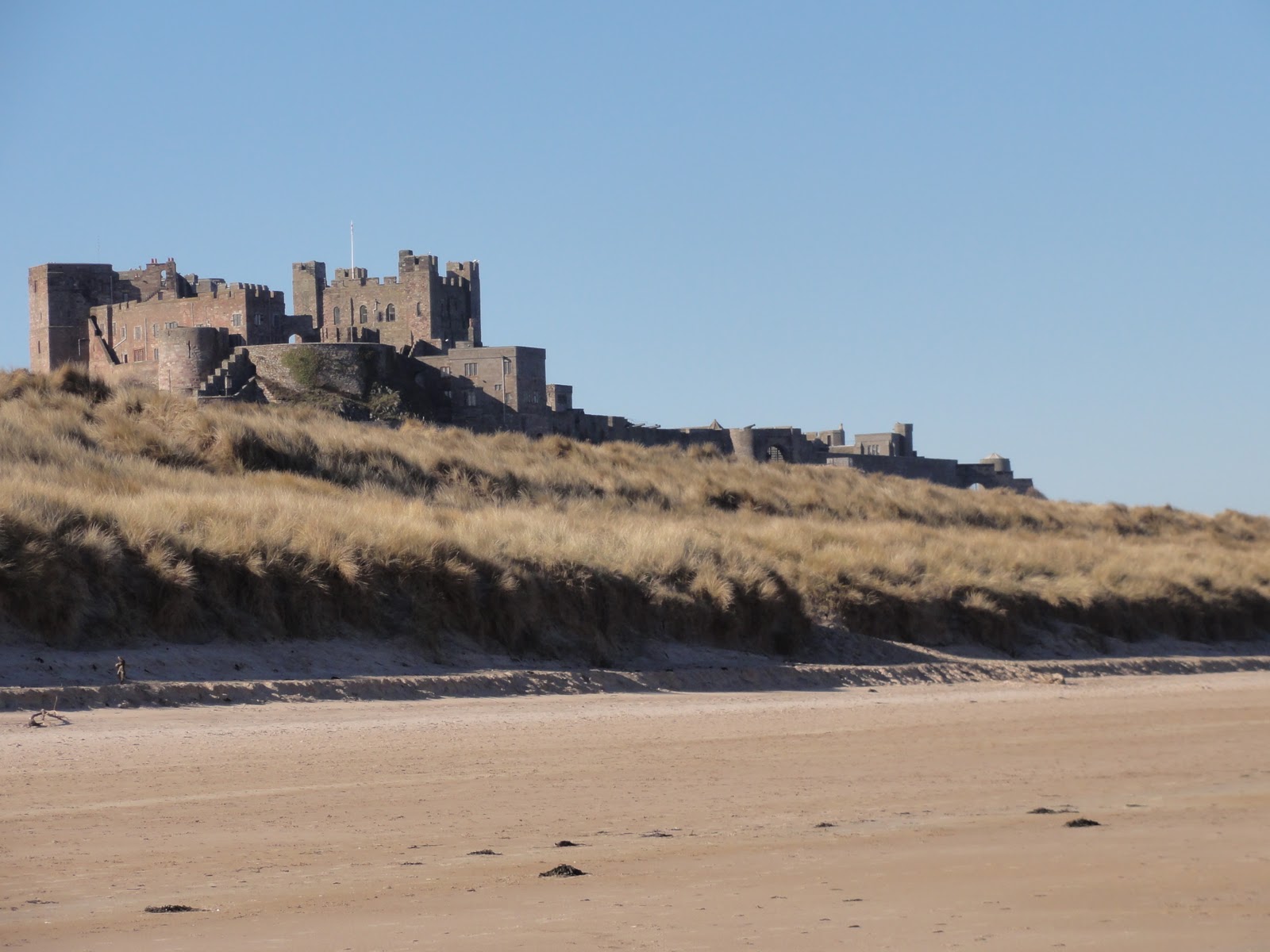
Soon the massive edifice of Bamburgh Castle appeared above the dunes perched on its dolerite mound but there was no time to visit it or the village made famous by the heroism of Grace Darling, we rounded the dunes and followed the edge of yet another golf course always being wary of the perennial flying balls   

We stopped at Black Rock for a well earned lunch taking in the extensive views over the glistering expanse of Budle Bay, watching the antics of an energetic puppy frolicking in the water and reflecting on the happiness that comes from simple pleasures.
The path continued west along the nature reserve Budle Bay towards Warren Mill well known as a caravan park but in a previous life used to supply flour to the Admiralty.
From her to Belford it was less inspiring although it was unusual having to phone the signalman at Tweedmouth for permission to walk across the Northeastern main railway line. This safely negotiated we then had to cross the busy A1 road before completing our day at Belford. Another good day’s walk!
  

Thursday, 3 February 2011


January 26th 2011

We returned to Craster this morning and parked the car at the quarry. The wind had dropped the sky was blue a grand day for walking as long as you are well wrapped up against the cold. We left the harbour heading along the turf path towards the imposing Dunstanburgh Castle built on an outcrop of the Great Whin Sill; basalt found throughout Northumbria, High Force tumbles over it; Hadrian’s Wall strides along it and the castles of Bamburgh and Dunstanburgh perch on top of it, resulting in no walls on the northern side.
We kept to the edge of the golf course ( there seems to be a lot of these in this area) as directed and soon returned to the coast with some very unusual rock formations that gave way again to the beautiful golden sandy beach and dunes. According to the guide book The Skaith may be difficult to cross at high tide or after rain, fortunately it was low tide !
After this a lovely sheltered spot was found for refreshments were we could enjoy the vista accompanied by the constant song of the sea when the creamy white waves relentlessly pounded the shore. Continuing along Embelton Bay arrived at Low Newton by the sea, well known locally for good food at the local pub and a centre for sailing and wind surfing. This is another area I would like to return and visit the pub (naturally) for a meal then explore the nature reserve, rock pools and  bird hides. As we rounded Newton Point we lost the dramatic view of
Dunstanburgh Castle but were rewarded with the 3 miles of glorious golden beach and a turquoise sea that make up beautiful  Beadnell Bay. Unfortunately our path did not take us into Beadnell so we had no opportunity to see the tiny harbour, famous for being the only west facing harbour on the east coast, the lime kilns and St. Ebba's chapel. Our course went through the caravan park and onto the drab main road, with the clock ticking and a bus to catch our pace had to be stepped up. We arrived at Seahouses with 15 minutes to spare. No celebratory meal this time but a cup of coffee  and corned beef pasty back at the car in Craster.


Saturday, 30 October 2010


   Oct 14th 2010
The weather was not so promising today so not the day for seeing our beautiful Northumberland coast line at its best and most photogenic. An alternative walk was called for which avoided the new Tyne Tunnel construction work and congested Western bypass.
We headed south to Castle Eden Dene, reputedly the largest area of semi natural woodland in the north east also one of the oldest surviving woodland which once covered most of Britain.


Parking at the visitors centre with its good stock of leaflets we set of down towards a very step gorge passing magnificent imposing trees, oak, yews, ash, wych elm and beech there were also skeletal reminders of the invasion of Dutch elm disease.
It was a contrasting walk at one point quite romantic with the golden leaves of autumn showering us like confetti at a wedding. Further along the contorted trunks and branches of the ancient yews could be the dormant spirits awaiting the call of the Lord of the Rings to rouse them from their slumber and that was before we even arrived at the huge Devil’s Lapstone! And what was that noise and shaking of the branches in this very still valley, some might say a squirrel but you never know in a place of such history.
Squirrels were sighted on the forest floor having no problem gathering fodder for the winter. A busy yellow wagtail entertained us  feeding along the small stream.


We left the circular walk to head through the meadow towards the coast were we had our refreshments. Suitably sustained we returned to the original path returning to the car park where the seemed to be an impromptu work meeting concerned about the recent government cut back with the quangos their employers Natural England being one under threat. What ever happens I hope their good work continues.